Triangle from three sides
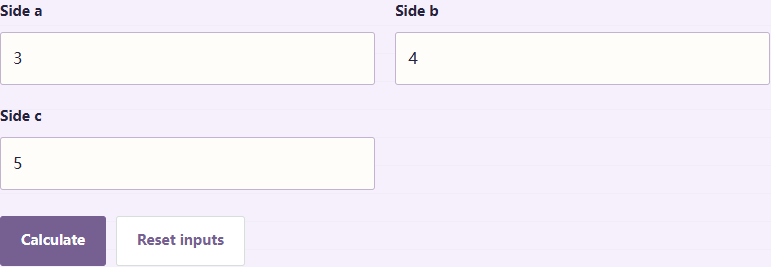
Enter three side lengths. NumberNest first checks the triangle inequalities, then reports perimeter and area (Heron’s formula). Degenerate or impossible triples are rejected instead of inventing an area.
Use cases
- Checking whether cut lengths can form a closed triangle.
- Homework on Heron’s formula.
- Comparing area before and after a small side change.
- Teaching why “all sides positive” is not enough.
- Sanity-checking a survey sketch’s three measured edges.
Rules
For sides a, b, c you need a+b>c, a+c>b, and b+c>a (strict inequality for positive area). Semi-perimeter s = (a+b+c)/2. Area = √[s(s−a)(s−b)(s−c)]. Units stay with the inputs; area is in squared units.
Worked example
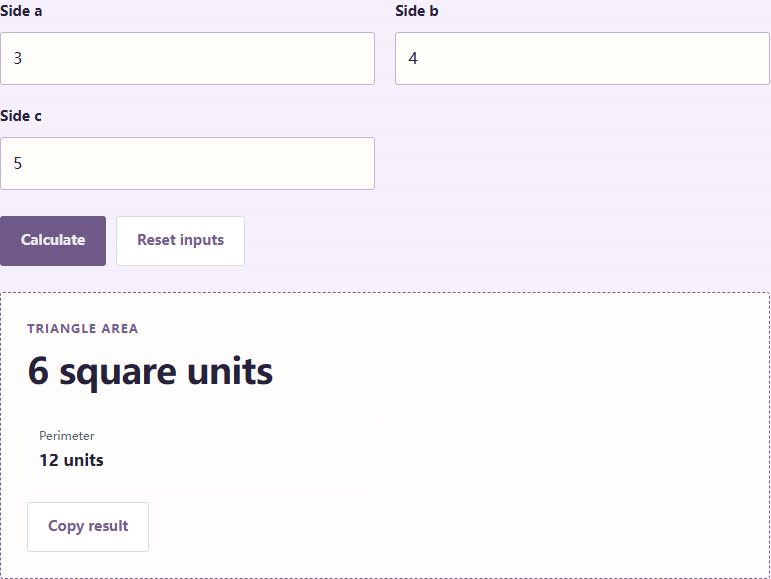
Sides 3, 4, 5 → inequalities hold → perimeter 12 → s = 6 → area = √(6·3·2·1) = 6. Sides 1, 2, 3 fail because 1+2 is not greater than 3.
Mistakes
- Allowing equality (flat “triangle” with zero area) when a positive area is required.
- Mixing inches and centimeters in one triple.
- Using degrees as if they were side lengths.
Limits
No angle solver, no SSA ambiguous case, no 3D faces. Educational geometry utility only.
Right triangles?
If a²+b²=c² within floating tolerance, you still get perimeter and area; the page does not specially label Pythagorean triples.
Near-degenerate triples?
Very skinny triangles can lose precision in Heron’s formula; treat tiny areas cautiously.
Contact
Report sides and the area you expected if something looks wrong.
How to double-check a three-side triangle
Before you treat the area as final, confirm all three lengths use the same unit and that you measured sides—not angles. Sketch the inequality quickly: the two shorter sides must beat the longest. If a field sketch is nearly flat, expect a tiny area and higher floating-point sensitivity in Heron’s formula.
Compare the printed perimeter with a+b+c by hand. For a right-looking triple, peek whether a²+b²≈c²; this page still reports perimeter and area without labeling Pythagorean triples. When a classmate’s spreadsheet differs, ask whether they allowed a zero-area “triangle” (equality in the inequality) while NumberNest rejects it.
Near-degenerate sides?
Very skinny triangles can lose precision. Re-measure or use higher-precision software if the area will drive a cut list.
Survey vs homework
For construction layout, treat this as a sanity check only—licensed survey methods belong elsewhere.
Keep the three inputs beside the area if you will cite the figure. NumberNest’s other geometry pages (circle, quadratic) answer different questions; stay on this worksheet when you only have sides.