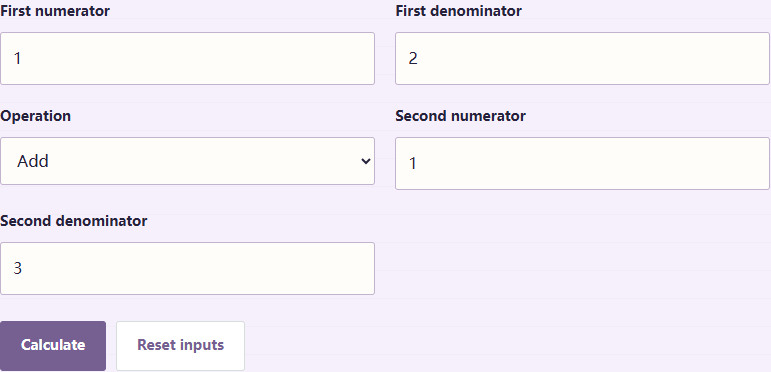
Fraction arithmetic with reduction
Add, subtract, multiply, or divide two fractions, then reduce the result by dividing numerator and denominator by their greatest common divisor. Zero denominators are rejected. Division by a zero numerator fraction is rejected.
Use cases
- Homework on rational arithmetic.
- Checking a recipe scale expressed in fractions.
- Reducing an unsimplified answer like 18/24 → 3/4.
- Comparing improper versus mixed-number forms (mixed output is optional mental work).
- Verifying that multiplying by the reciprocal implements division.
Rules
a/b ± c/d uses a common denominator. Multiplication multiplies numerators and denominators. Division multiplies by the reciprocal. Signs follow ordinary integer rules. The reduced form keeps the denominator positive when possible.
Example
1/2 + 1/6 = 3/6 + 1/6 = 4/6 → reduce by 2 → 2/3. 3/4 ÷ 9/8 = 3/4 × 8/9 = 24/36 → 2/3.
Mistakes
- Adding numerators and denominators separately.
- Forgetting to flip the second fraction when dividing.
- Allowing denominator 0.
Limits
Integer numerators/denominators within ordinary JS safe ranges. Not a full rational CAS; decimals must be converted to fractions first if you need exactness.
Mixed numbers?
Convert to improper fractions before entry (e.g., 2 1/3 → 7/3).
Decimals?
This tool expects integers in numerator and denominator fields.
Why reduce?
Equal rationals should share a canonical simple form for comparison.
Keeping fraction results canonical
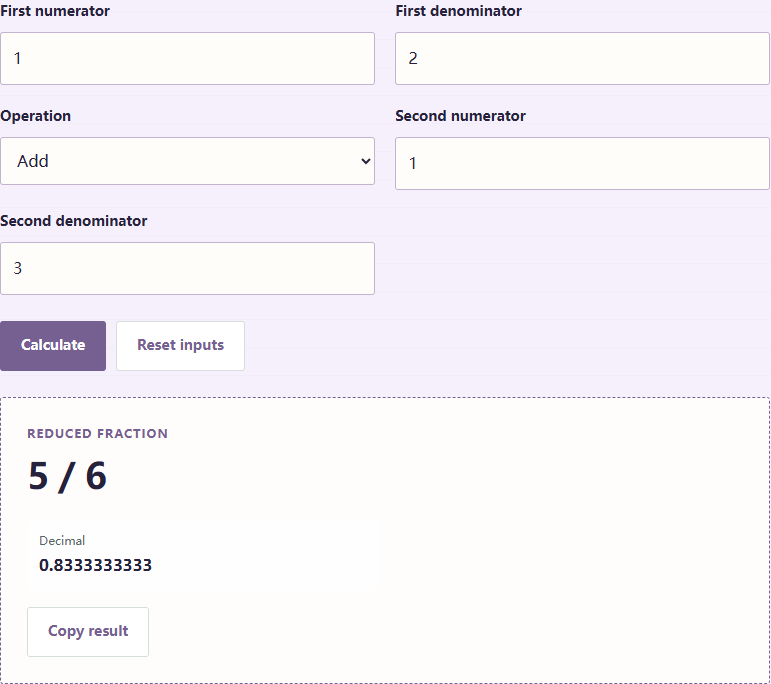
After each operation, glance at the reduced form: numerator and denominator should share no common factor greater than 1, and the denominator should stay positive. Mixed numbers belong as improper fractions before you press Calculate (2⅓ → 7/3).
If addition looks wrong, rebuild the common denominator on paper once. For division, confirm you multiplied by the reciprocal rather than dividing numerators alone. Integer fields reject decimals—convert 0.5 to 1/2 first when you need exact rationals.
Zero denominators
Any zero denominator is invalid. Division by a zero numerator fraction is also rejected.
Comparing to a calculator decimal
0.666… may match 2/3 only after rounding; prefer the reduced fraction for exact work.
Save both input fractions and the operation with the reduced answer when grading yourself. Statistics and circle tools do not replace rational arithmetic—keep fraction work on this page.