Quadratic roots with an explicit leading coefficient
Solve ax² + bx + c = 0 for real or complex roots. NumberNest requires a ≠ 0. The discriminant Δ = b² − 4ac decides whether roots are real and distinct, real and repeated, or a complex conjugate pair.
Useful scenarios
- Homework checks on the quadratic formula.
- Finding intercepts of a parabola before sketching.
- Seeing how a tiny change in coefficients moves the roots.
- Confirming that a repeated root appears when Δ = 0.
- Comparing a by-hand completion-of-square result with the formula.
Formula
x = (−b ± √Δ) / (2a). When Δ < 0, √Δ is treated as imaginary and roots are reported as a complex pair. Coefficients should be finite numbers; extreme magnitudes can suffer floating-point cancellation.
Worked example
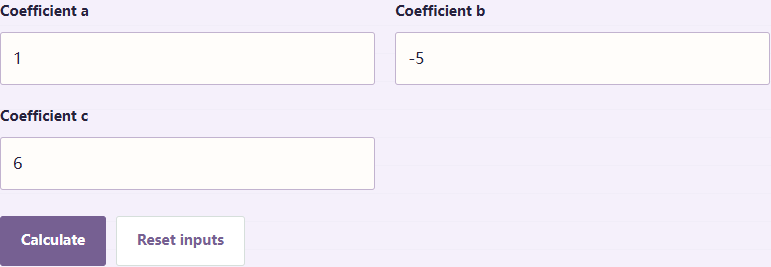
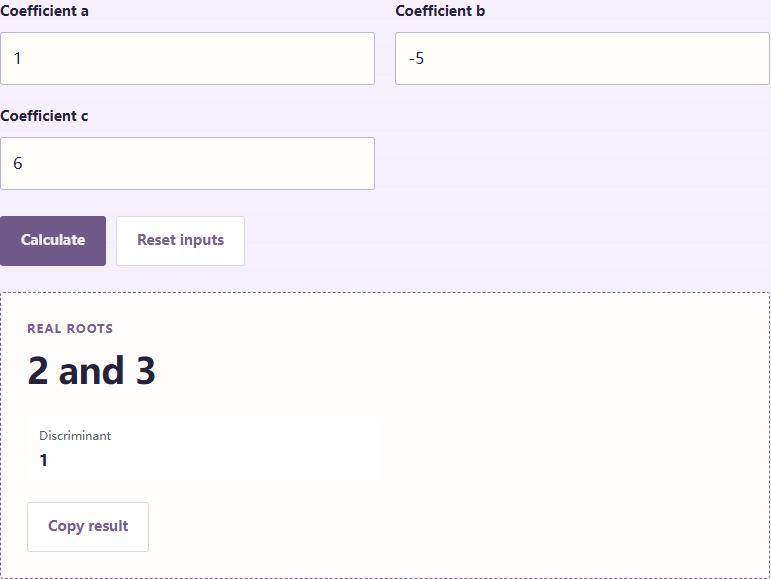
For x² − 5x + 6 = 0 (a=1, b=−5, c=6): Δ = 25 − 24 = 1. Roots = (5 ± 1)/2 → 3 and 2. For x² + 1 = 0, Δ = −4 → roots ± i.
Common mistakes
- Setting a = 0 and expecting a quadratic (that case is linear).
- Dropping the ± and reporting only one root.
- Sign errors when b is already negative.
- Comparing rounded display values to exact symbolic answers without tolerance.
Limits
This is algebra practice, not a CAS. Multiple roots of higher-degree polynomials, Sturm sequences, and exact radical simplification of messy discriminants are out of scope.
Are complex roots shown?
Yes, when Δ is negative, as a conjugate pair under the usual real-coefficient assumption.
Vertex form?
Use the roots and leading coefficient, or rewrite by completing the square offline; this page targets the standard formula.
Need a correction?
Send a, b, c and the roots you expected via the contact page.
Reading quadratic roots without surprises
Write the equation as ax²+bx+c=0 with a≠0 before you compare answers. Check the sign of b carefully—minus signs in the formula are a common homework trap. Glance at Δ=b²−4ac: positive means two real roots, zero a repeated root, negative a complex conjugate pair under real coefficients.
If a textbook wants exact radicals and this page shows decimals, the methods still agree within rounding. Extreme coefficients can cancel in floating point; scale the equation or use a CAS when coefficients span many orders of magnitude. Completing the square offline is a good second method for one practice problem.
Complex roots format
When Δ<0, expect a conjugate pair. Matching a CAS may require writing i explicitly the way your course prefers.
Linear case
If a=0, this is not a quadratic—use a linear solver instead of forcing the formula.
Record a, b, c with the roots when you submit homework. For descriptive lists of numbers, switch to the statistics page rather than shoehorning data into a quadratic.